
The island where Columbus imagined the world
For four days, Porto Santo exchanges the quiet beauty of its golden landscape for the sounds of another age. With landings, processions, music, fire and a 16th-century market, the Columbus Festival recalls the period when this small Atlantic island became entwined with one of history’s greatest voyages.
Before America appeared on European maps, there was the Atlantic.
It was an uncertain expanse, inhabited by currents, winds, imagined monsters and islands that seemed to appear and disappear from navigational charts. At the edge of that known world lay the Madeira archipelago — and, a little farther out, a small, arid and luminous island with an unexpectedly golden beach.
Porto Santo seemed then, as it does today, like a place made for contemplating the horizon.
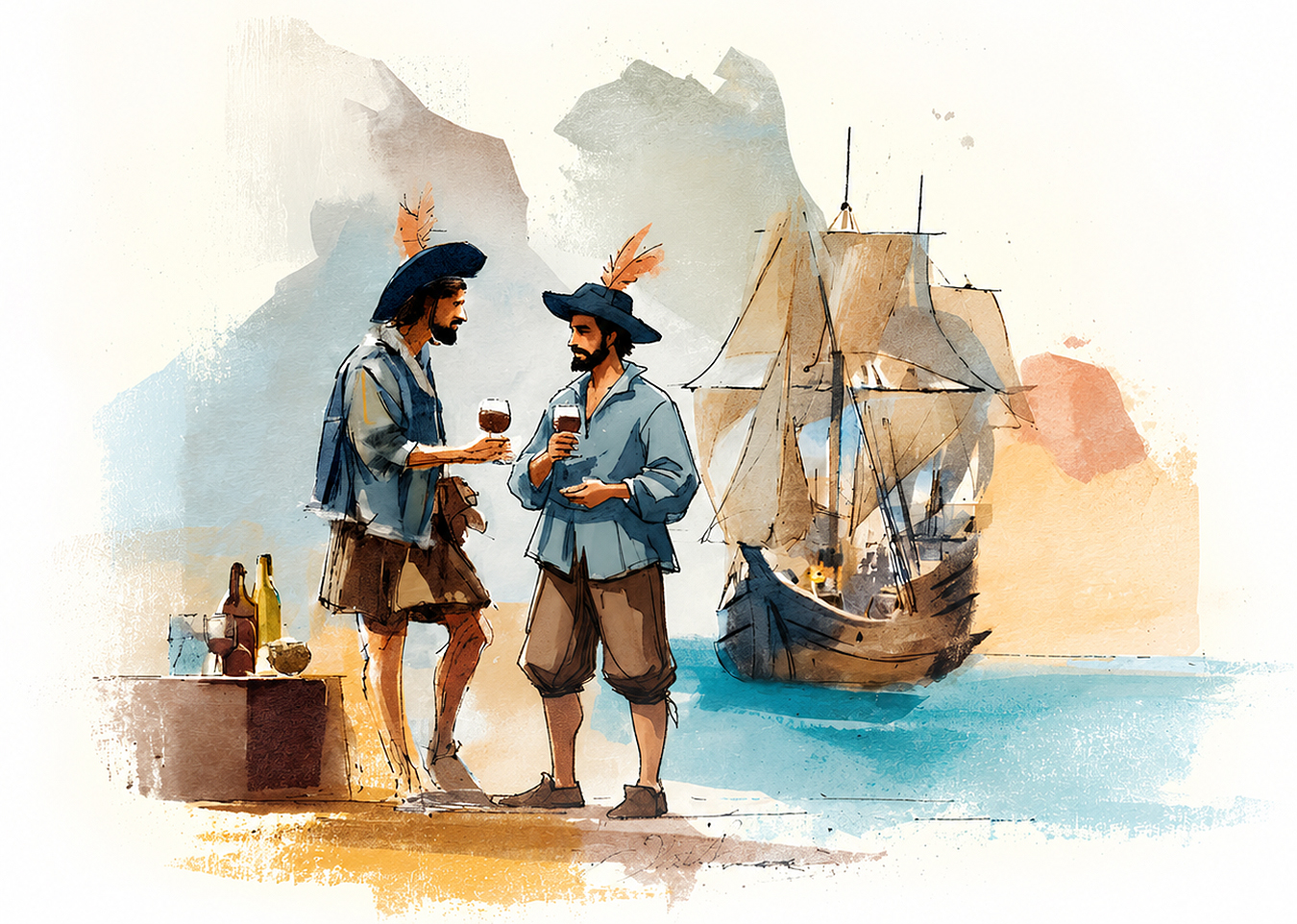
It was here that Christopher Columbus found more than a port of call. The navigator arrived in the archipelago in the late 15th century, when Funchal was prospering through the sugar trade. He married Filipa Moniz, daughter of Bartolomeu Perestrelo, the first captain-donee of Porto Santo, and lived for a time between these islands. Their son, Diego, was born here.
The documented story ends somewhere around this point. Beyond it lies a more intriguing territory: that of possibility.
Did Columbus study in Porto Santo the winds arriving from the west? Did he listen to sailors telling stories of unfamiliar pieces of wood carried in by the currents? Did he stand on this beach, looking across the ocean and wondering what might exist beyond the blue line?
We do not know. Yet it is difficult to spend time in Porto Santo without understanding how the horizon might become an obsession.
Before America appeared on European maps, there was the Atlantic.
It was an uncertain expanse, inhabited by currents, winds, imagined monsters and islands that seemed to appear and disappear from navigational charts. At the edge of that known world lay the Madeira archipelago — and, a little farther out, a small, arid and luminous island with an unexpectedly golden beach.
Porto Santo seemed then, as it does today, like a place made for contemplating the horizon.
It was here that Christopher Columbus found more than a port of call. The navigator arrived in the archipelago in the late 15th century, when Funchal was prospering through the sugar trade. He married Filipa Moniz, daughter of Bartolomeu Perestrelo, the first captain-donee of Porto Santo, and lived for a time between these islands. Their son, Diego, was born here.
The documented story ends somewhere around this point. Beyond it lies a more intriguing territory: that of possibility.
Did Columbus study in Porto Santo the winds arriving from the west? Did he listen to sailors telling stories of unfamiliar pieces of wood carried in by the currents? Did he stand on this beach, looking across the ocean and wondering what might exist beyond the blue line?
We do not know. Yet it is difficult to spend time in Porto Santo without understanding how the horizon might become an obsession.
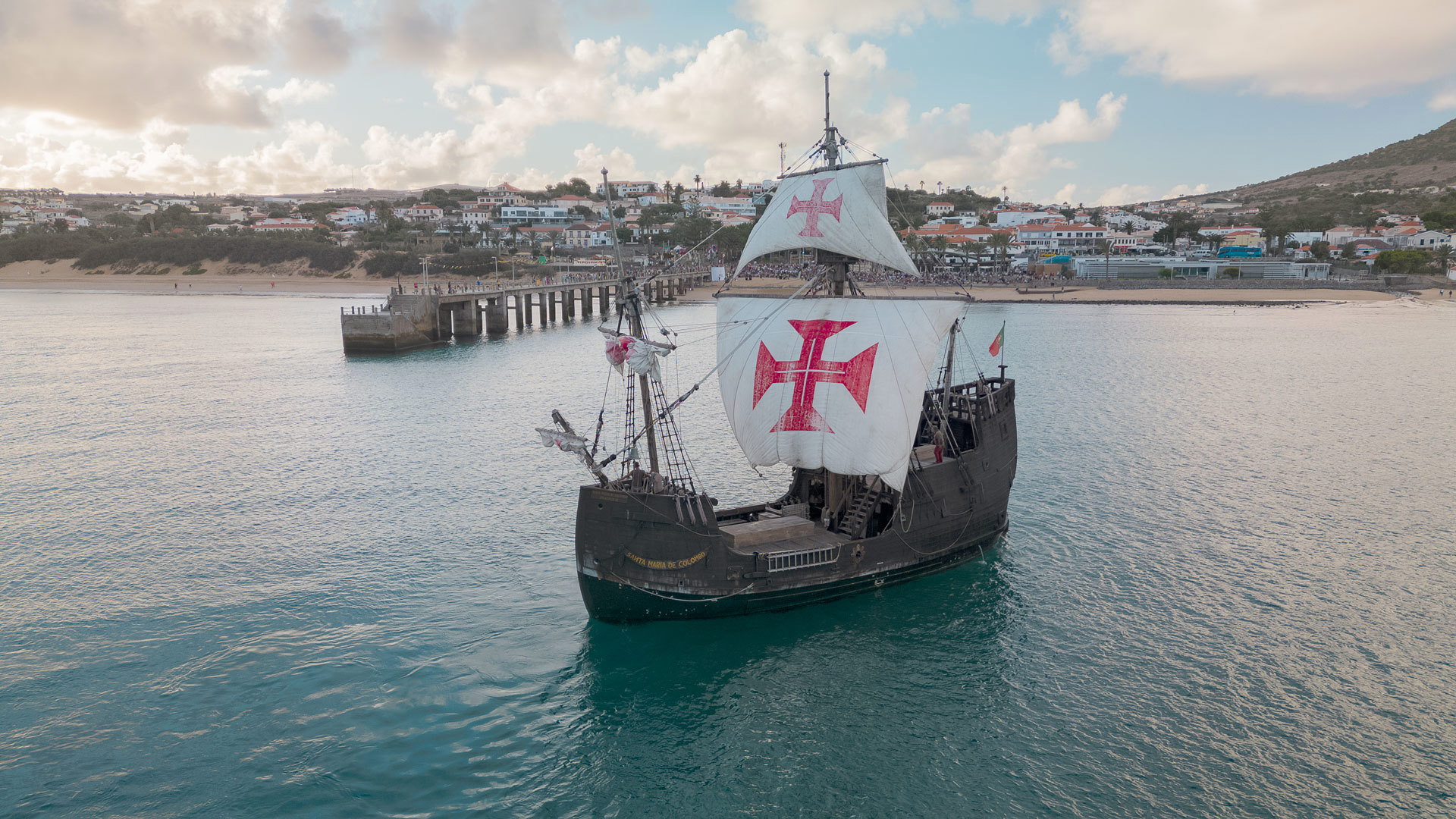
©visitmadeira
When the past comes ashore in Vila Baleira
Every September, this historical connection leaves the archives and returns to the streets.
From 17 to 20 September 2026, Vila Baleira becomes an open-air stage for the Columbus Festival. The event does not attempt to reconstruct history with the hushed precision of a museum. Instead, it returns it to the street: noisy, theatrical and inhabited by merchants, musicians, acrobats, sailors and characters dressed for another century.
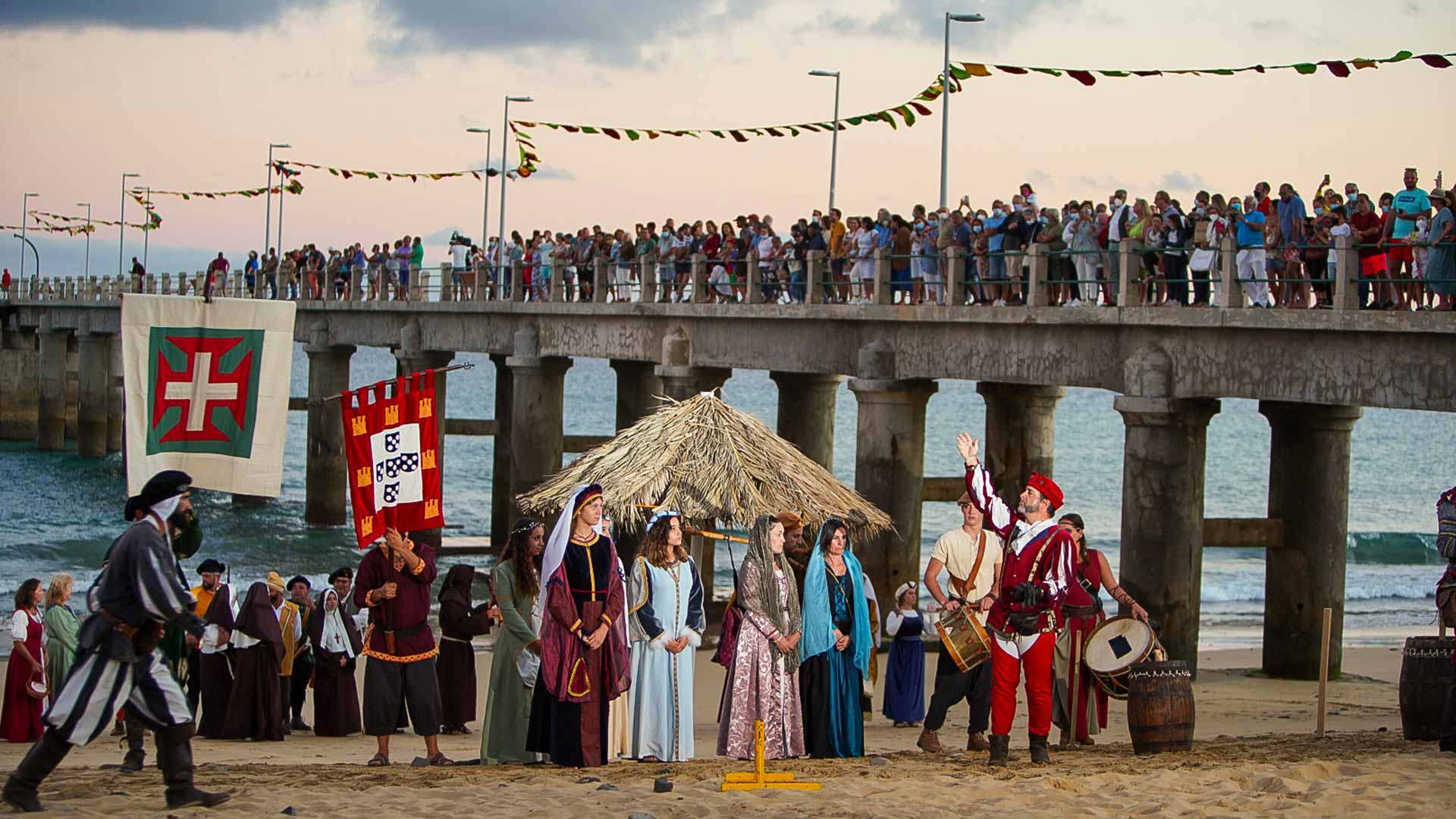
The festival opens on 17 September with a recreation of Christopher Columbus’s arrival, accompanied by his crew. The navigator comes ashore to find the island occupied by a 16th-century market — a small town within the town, filled with stalls, craftspeople, food, street cries and movement.
It is at this point that everyday Porto Santo begins to disappear.
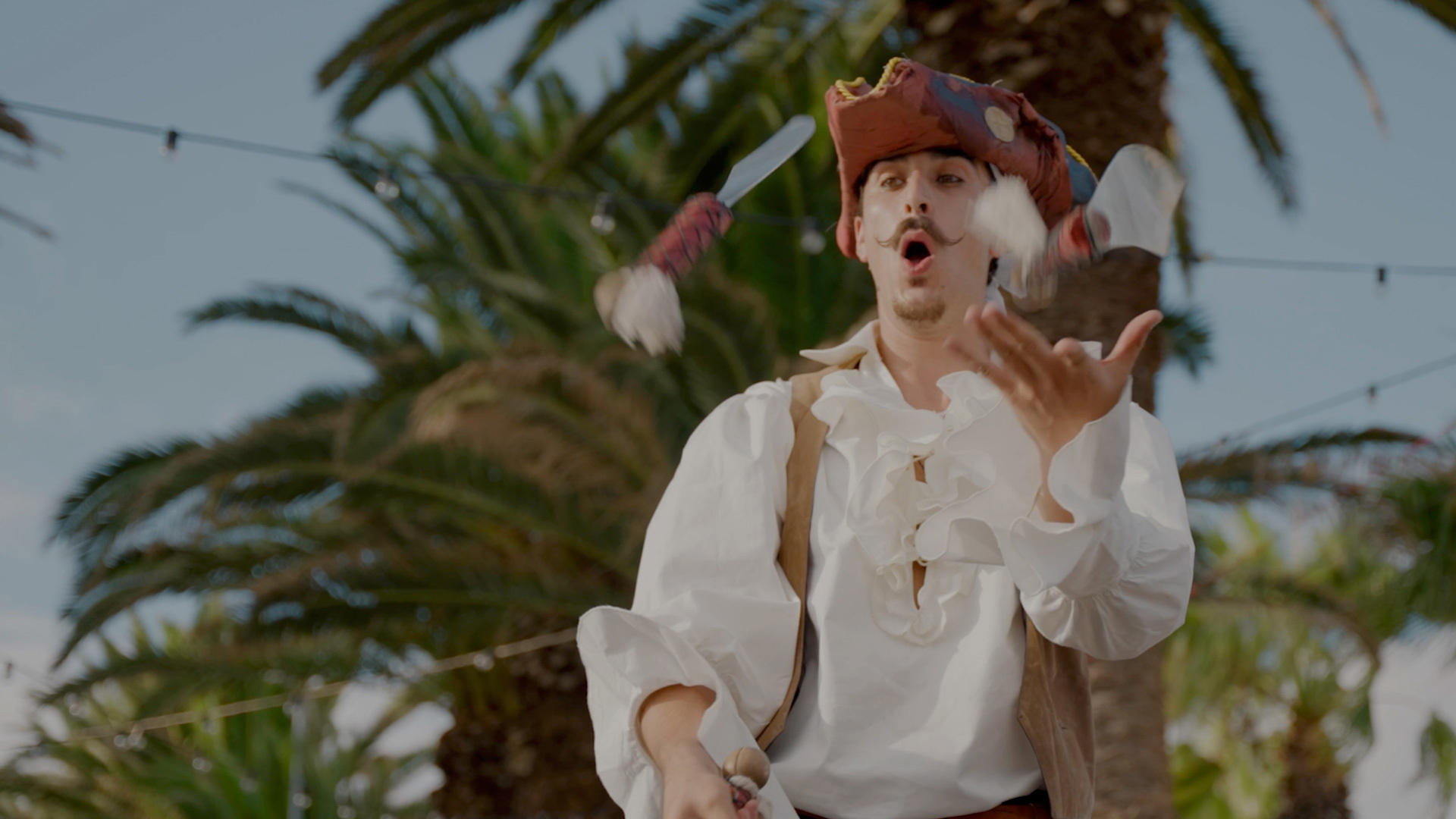
For four days, historical costumes mingle with visitors in the streets of Vila Baleira. There are daily processions, music, dance, street theatre, acrobatics, juggling and fire performances. The 2026 edition features approximately 58 performances, including 25 musical acts, 16 dance appearances and 11 interventions spanning other performing arts.
The scale remains agreeably human. That is one of the festival’s defining qualities: it does not take place inside an enclosure separated from the island, but in the centre of its daily life. Squares, streets and buildings become part of the staging, while local students, teachers, associations and performers help to create the spectacle.
Here, the audience does more than watch the performance. It gradually becomes part of it.
When the past comes ashore in Vila Baleira
Every September, this historical connection leaves the archives and returns to the streets.
From 17 to 20 September 2026, Vila Baleira becomes an open-air stage for the Columbus Festival. The event does not attempt to reconstruct history with the hushed precision of a museum. Instead, it returns it to the street: noisy, theatrical and inhabited by merchants, musicians, acrobats, sailors and characters dressed for another century.
The festival opens on 17 September with a recreation of Christopher Columbus’s arrival, accompanied by his crew. The navigator comes ashore to find the island occupied by a 16th-century market — a small town within the town, filled with stalls, craftspeople, food, street cries and movement.
It is at this point that everyday Porto Santo begins to disappear.
For four days, historical costumes mingle with visitors in the streets of Vila Baleira. There are daily processions, music, dance, street theatre, acrobatics, juggling and fire performances. The 2026 edition features approximately 58 performances, including 25 musical acts, 16 dance appearances and 11 interventions spanning other performing arts.
The scale remains agreeably human. That is one of the festival’s defining qualities: it does not take place inside an enclosure separated from the island, but in the centre of its daily life. Squares, streets and buildings become part of the staging, while local students, teachers, associations and performers help to create the spectacle.
Here, the audience does more than watch the performance. It gradually becomes part of it.
©visitmadeira
©visitmadeira
Four days between the ocean and the 15th century
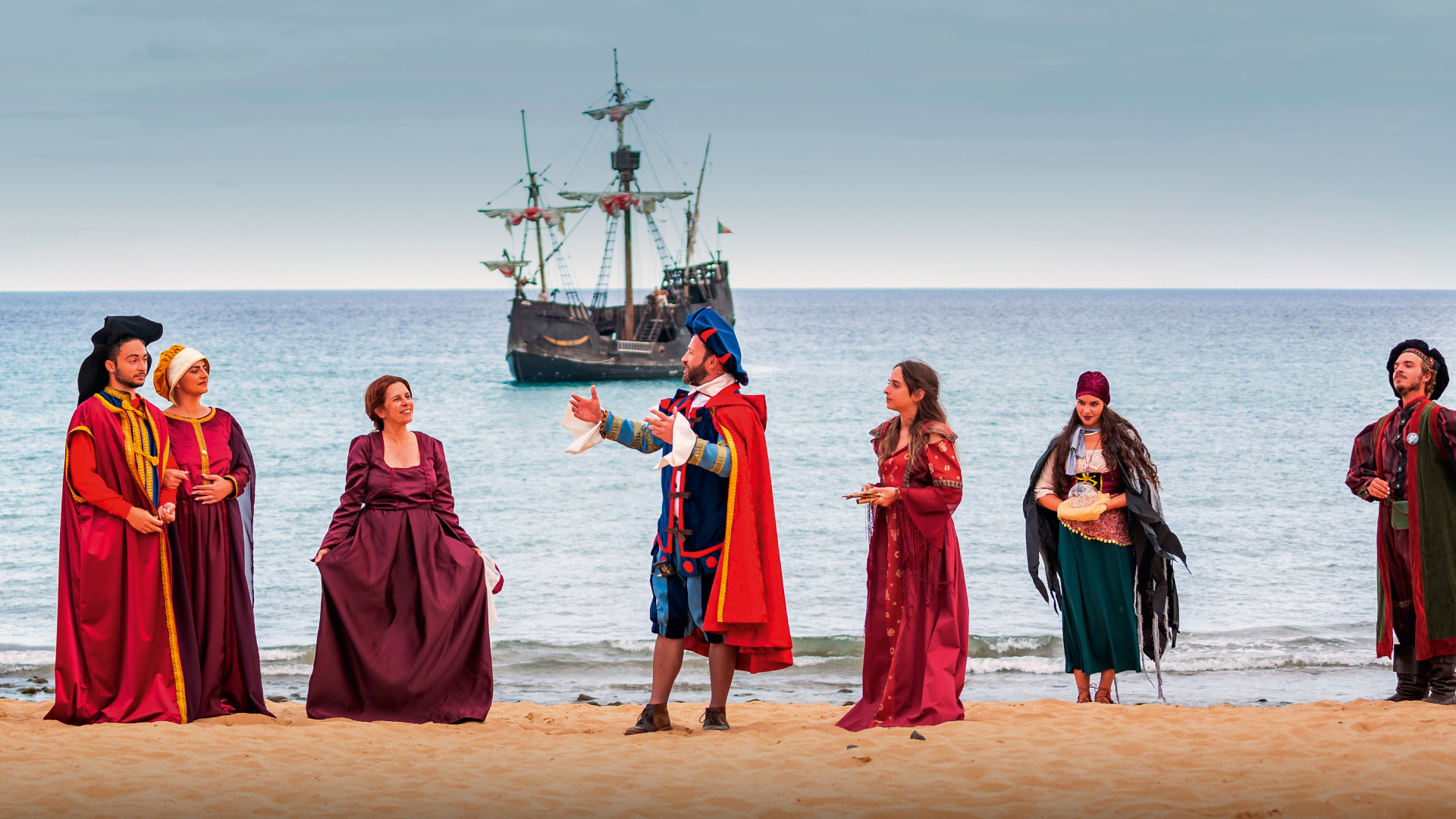
On Thursday 17 September, the main event is the recreation of Christopher Columbus’s arrival aboard the Santa Maria. The performance brings together Teatro Avesso, the Cenas Ilimitadas theatre company and students from Porto Santo’s secondary school.
The same day sees the première of “(EU)phoria”, a circus performance that returns on 18 September. Its language is contemporary, yet it sits naturally within the festival’s world: bodies in motion, risk, surprise and the feeling that something unexpected might appear around the next corner.
On 18 and 19 September, the historical narrative reaches the Porto Santo Golf course with the ninth Colombo’s Golf Trophy. The tournament offers another way of experiencing the island: as an end-of-summer destination where beach, culture and golf can belong to the same journey.
Concerts take place on 18, 19 and 20 September, extending the celebrations into the evening. Throughout the festival, daily processions and street performances animate Vila Baleira, while six food spaces and seven craft stalls celebrate the flavours, skills and materials of the archipelago.
On 19 September, a cocktail festival organised with the Madeira Bartenders Association introduces a more contemporary note. The idea of travel reappears inside the glass: spices, Madeira wine, fruit and Atlantic ingredients can tell stories as effectively as a character or theatrical set.
The programme also includes exhibitions, events at the Municipal Library and activities involving local schoolchildren along Alameda do Infante D. Henrique. The festival is therefore not simply a commemoration of a celebrated navigator. It is also a portrait of contemporary Porto Santo, created by the people who live here.
Four days between the ocean and the 15th century
On Thursday 17 September, the main event is the recreation of Christopher Columbus’s arrival aboard the Santa Maria. The performance brings together Teatro Avesso, the Cenas Ilimitadas theatre company and students from Porto Santo’s secondary school.
The same day sees the première of “(EU)phoria”, a circus performance that returns on 18 September. Its language is contemporary, yet it sits naturally within the festival’s world: bodies in motion, risk, surprise and the feeling that something unexpected might appear around the next corner.
On 18 and 19 September, the historical narrative reaches the Porto Santo Golf course with the ninth Colombo’s Golf Trophy. The tournament offers another way of experiencing the island: as an end-of-summer destination where beach, culture and golf can belong to the same journey.
Concerts take place on 18, 19 and 20 September, extending the celebrations into the evening. Throughout the festival, daily processions and street performances animate Vila Baleira, while six food spaces and seven craft stalls celebrate the flavours, skills and materials of the archipelago.
On 19 September, a cocktail festival organised with the Madeira Bartenders Association introduces a more contemporary note. The idea of travel reappears inside the glass: spices, Madeira wine, fruit and Atlantic ingredients can tell stories as effectively as a character or theatrical set.
The programme also includes exhibitions, events at the Municipal Library and activities involving local schoolchildren along Alameda do Infante D. Henrique. The festival is therefore not simply a commemoration of a celebrated navigator. It is also a portrait of contemporary Porto Santo, created by the people who live here.
©visitmadeira
An island between seasons
The Columbus Festival takes place at one of the best times of year to discover Porto Santo.
September retains the long, bright days and warm water of summer, but returns a little space to the beach. The island settles into a quieter rhythm, despite the festival’s energy. Mornings can be spent walking beside the Atlantic or playing golf; by late afternoon, Vila Baleira begins to fill with musicians, performers and travellers.
That combination makes the festival more than a cultural diary entry. It becomes a different way of inhabiting the island.
Porto Santo is usually described through its nine-kilometre beach — and rightly so. Yet to stop at the beach would be to miss half of the story. There is a house associated with Columbus, a compact historical centre, viewpoints overlooking an almost lunar volcanic landscape and a relationship with the sea that predates tourism by centuries.
During the festival, these elements seem to draw closer together. Geography becomes scenery; memory becomes performance; and visitors are invited to do what Columbus may once have done here: look out across the Atlantic and imagine other worlds.
An island between seasons
The Columbus Festival takes place at one of the best times of year to discover Porto Santo.
September retains the long, bright days and warm water of summer, but returns a little space to the beach. The island settles into a quieter rhythm, despite the festival’s energy. Mornings can be spent walking beside the Atlantic or playing golf; by late afternoon, Vila Baleira begins to fill with musicians, performers and travellers.
That combination makes the festival more than a cultural diary entry. It becomes a different way of inhabiting the island.
Porto Santo is usually described through its nine-kilometre beach — and rightly so. Yet to stop at the beach would be to miss half of the story. There is a house associated with Columbus, a compact historical centre, viewpoints overlooking an almost lunar volcanic landscape and a relationship with the sea that predates tourism by centuries.
During the festival, these elements seem to draw closer together. Geography becomes scenery; memory becomes performance; and visitors are invited to do what Columbus may once have done here: look out across the Atlantic and imagine other worlds.
©visitmadeira
Practical information
Columbus Festival 2026
Dates: 17–20 September
Location: Vila Baleira, Porto Santo
Opening: 17 September at 15.00
Closing: 20 September at 23.00
Highlights include:
- the recreation of Christopher Columbus’s arrival;
- a 16th-century market;
- daily historical processions;
- music, dance and street theatre;
- acrobatics, juggling and fire performances;
- the “(EU)phoria” circus show on 17 and 18 September;
- the Colombo’s Golf Trophy on 18 and 19 September;
- a cocktail festival on 19 September;
- local food, crafts, exhibitions and cultural activities.
For timings, the complete programme and any last-minute changes, visit the official Columbus Festival page at Visit Madeira.